
Is It ADHD or OCD? Untangling Racing Thoughts from Intrusive Thoughts
Cara Kiff, PhD
Clinical Psychologist | Behavioral Health
August 6, 2026
One of the questions I hear most often in consultation — from parents, from adults seeking their own evaluation, and sometimes from other clinicians — is some version of: "Is this ADHD or OCD? The thoughts won't stop either way." It's a genuinely hard distinction to make, and the research bears that out: estimates vary across studies, with reported ADHD prevalence among people with OCD ranging from roughly 12% in some samples to over 25% in others (Sheppard et al., 2010). The two conditions are frequently mistaken for one another, and just as often, missed entirely when they occur together.
The thoughts feel different — even when they look similar from the outside
On the surface, both conditions involve a mind that won't settle. But the relationship a person has with their thoughts tends to differ in a clinically meaningful way.
In OCD, intrusive thoughts are typically ego-dystonic — they feel foreign, unacceptable, and at odds with the person's values, which is precisely why they generate so much distress. A parent might have an unwanted thought about harm coming to their child and feel horrified by it, then develop rituals or mental compulsions specifically to neutralize that thought and the anxiety it creates (Abramovitch & Schweiger, 2009; Abramovitch & Mittelman, International OCD Foundation).
In ADHD, unwanted or racing thoughts happen too, but they tend to move rather than stick. A 2023 study distinguishing racing thoughts from ordinary mind-wandering in adults with ADHD found that racing thoughts — described by participants as multiple ideas occurring simultaneously or "constantly on the go" — were closely tied to emotional lability, while mind-wandering was a separate, unrelated phenomenon (Martz et al., 2023). Critically, the researchers found ADHD-related racing thoughts weren't inherently distressing in the way OCD obsessions are; they were more a feature of mental restlessness than of moral or safety-related fear.
Why the overlap gets missed clinically
Part of what makes differentiation difficult is that OCD can create real attentional problems that mimic ADHD. When a person is mentally occupied by an obsession or a compulsion running in the background, they may lose track of conversations, forget tasks, or appear distracted — not because their attention system is impaired, but because a significant share of their cognitive resources are tied up managing the obsession (Abramovitch & Mittelman, International OCD Foundation). This is sometimes called the "cognitive cost" of obsessions, and it means a clinician evaluating attention symptoms in isolation, without asking about the content and function of the thoughts, risks misdiagnosing OCD as ADHD, or vice versa.
A rough clinical heuristic (not a substitute for full evaluation):
OCD: thought is unwanted and distressing → person tries to suppress, neutralize, or ritualize in response → temporary relief, then the cycle repeats.
ADHD: thought arises, causes brief discomfort at most, and gets displaced by the next thought → no ritual, no sustained attempt at neutralization.
Why this matters for treatment
Getting the distinction right isn't academic — it changes treatment. OCD responds specifically to Exposure and Response Prevention (ERP), which involves not neutralizing the anxiety the thought creates. Applying ERP-style intervention to what is actually ADHD-driven mental restlessness misses the mark, and conversely, treating true OCD purely as an attention problem (e.g., with stimulant medication alone) can in some cases intensify obsessive symptoms.
A comprehensive evaluation that assesses both the presence and the function of intrusive or racing thoughts is the only reliable way to tell them apart — and comorbid presentations, which are common, require a treatment plan that addresses both. If you're trying to work out which one you or your child might be dealing with, that's exactly what a full evaluation is designed to sort out.
References
Abramovitch, A., & Schweiger, A. (2009). Unwanted intrusive and worrisome thoughts in adults with Attention Deficit/Hyperactivity Disorder. Psychiatry Research, 168(3), 230–233. https://doi.org/10.1016/j.psychres.2008.06.004
Abramovitch, A., & Mittelman, A. OCD and ADHD Dual Diagnosis, Misdiagnosis, and the Cognitive "Cost" of Obsessions. International OCD Foundation. https://iocdf.org/expert-opinions/expert-opinion-ocd-and-adhd-dual-diagnosis-misdiagnosis-and-the-cognitive-cost-of-obsessions/
Martz, E., Weiner, L., Bonnefond, A., & Weibel, S. (2023). Disentangling racing thoughts from mind wandering in adult attention deficit hyperactivity disorder. Frontiers in Psychology, 14, 1166602. https://doi.org/10.3389/fpsyg.2023.1166602
Sheppard, B., Chavira, D., Azzam, A., Grados, M. A., Umaña, P., Garrido, H., & Mathews, C. A. (2010). ADHD prevalence and association with hoarding behaviors in childhood-onset OCD. Depression and Anxiety, 27(7), 667–674. https://doi.org/10.1002/da.20691
Worry or Anxiety Disorder? A Practical Way to Tell the Difference
Cara Kiff, PhD
Clinical Psychologist | Behavioral Health
August 4, 2026
Every child worries. Worry about a test, a friendship, the first day at a new school — that's not just normal, it's useful. It's what pushes a child to study, to make amends, to be careful crossing the street. The question parents actually need answered isn't "does my child worry" — almost all do — it's when worry has crossed into something that needs professional support.
Three questions that matter more than the worry itself
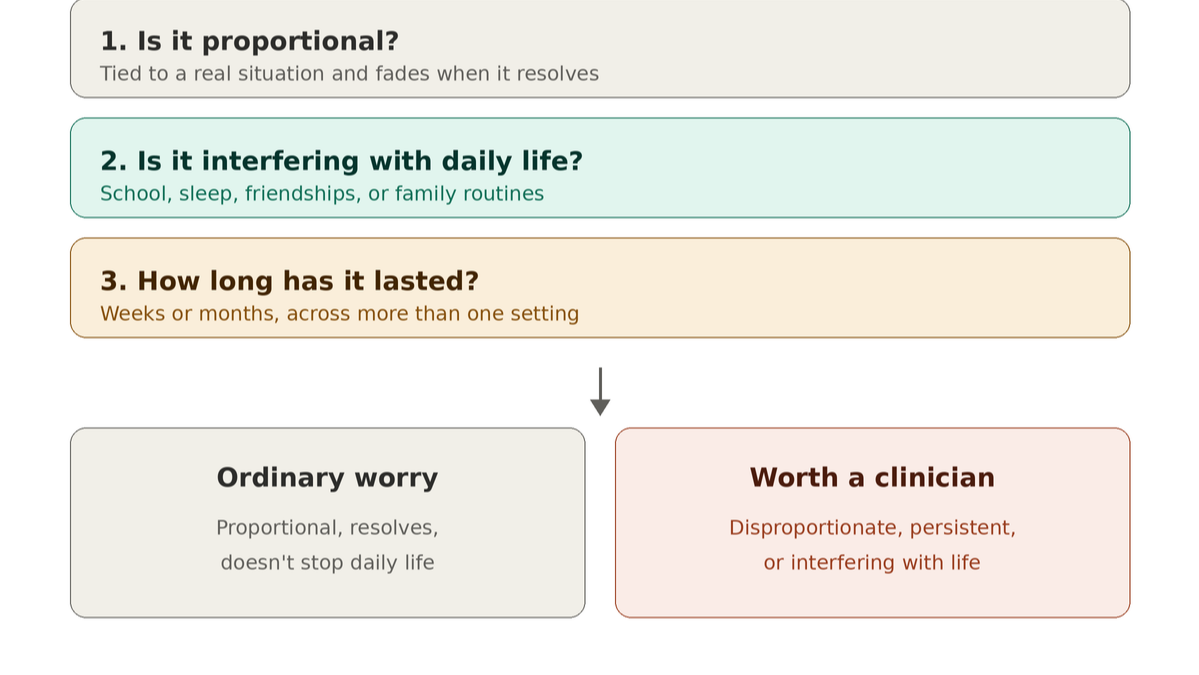
1. Is it proportional? Ordinary worry is tied to something real and fades once the situation resolves. An anxiety disorder tends to involve fear that's out of proportion to the actual risk, or that persists well past the event that triggered it.
2. Is it interfering with daily life? This is the clinical line in the sand. A child who's nervous about a test but still takes it is worrying. A child who cannot go to school, cannot sleep in their own room, or is missing out on friendships and activities because of fear is showing signs of impairment — the hallmark of an anxiety disorder rather than everyday worry.
3. How long has it lasted? Situational nervousness resolves. Anxiety disorders tend to persist for weeks or months and often show up across more than one setting — home and school, not just one or the other.
Why this matters: anxiety disorders are common, and highly treatable
Anxiety disorders are among the most common mental health conditions in childhood and adolescence. The encouraging part is that they also respond exceptionally well to treatment. A large meta-analysis of 81 randomized controlled trials — over 3,300 children receiving CBT — found cognitive behavioral therapy consistently effective for reducing childhood anxiety across individual, group, family-based, and remote treatment formats (comprehensive CBT meta-analysis, 2020). Other analyses have found moderate-to-large effects compared to no treatment, with the majority of children showing significant, lasting improvement well beyond the end of treatment (Warwick et al., meta-analysis of secondary outcomes).
CBT for children isn't an adult approach scaled down. It typically involves teaching a child to notice anxious thoughts, gradually and safely approach the situations they've been avoiding, and build a toolkit of coping skills — with parents actively involved in supporting the process at home, not just dropping their child off at the therapy door.
A practical next step
If worry is proportional, resolves on its own, and doesn't stop your child from doing what they need to do — that's ordinary childhood. If it's persistent, disproportionate, or getting in the way of school, sleep, friendships, or family life, that's worth a conversation with a clinician who specializes in pediatric anxiety. Early treatment tends to be shorter and more effective than treatment that starts after years of accommodation and avoidance have built up around the fear.
References
Effectiveness of cognitive behavioral therapy (CBT) for child and adolescent anxiety disorders across different CBT modalities and comparisons: a systematic review and meta-analysis. (2020). Journal of Affective Disorders (PubMed 31738631).
Warwick, H., et al. Cognitive-behavior therapy for children and adolescents with anxiety disorders: A meta-analysis of secondary outcomes. Clinical Psychology Review.
American Academy of Child and Adolescent Psychiatry practice guidance on CBT for pediatric anxiety disorders.

Photo Credit: Brain & Behavior Foundation eNews
Research highlights that therapy and medications complement one another
I often work with families unsure about whether therapy or medications are the best route. This can be a tricky puzzle and any decisions must be balanced against parents' values and beliefs about what is best for their child.
My recommendations are often based on the best evidence available in the field balanced by what works best for each family and child. Research continues to support that it is not an either or decision, but that medications and therapy can often be complementary particularly in cases when children's anxiety is high and may interfere with therapy. For the latest research on this topic read more here: Brain & Behavior eNews Meds and Therapy improve Severe Anxiety in Children.
Families often arrive in my office with a version of the same description: "His brain never shuts off." Or, from an adult client: "I can't stop thinking, and I can't stop worrying about what people think of me."
That description fits at least three different things — and which one it is changes what actually helps.
Three kinds of "won't stop"
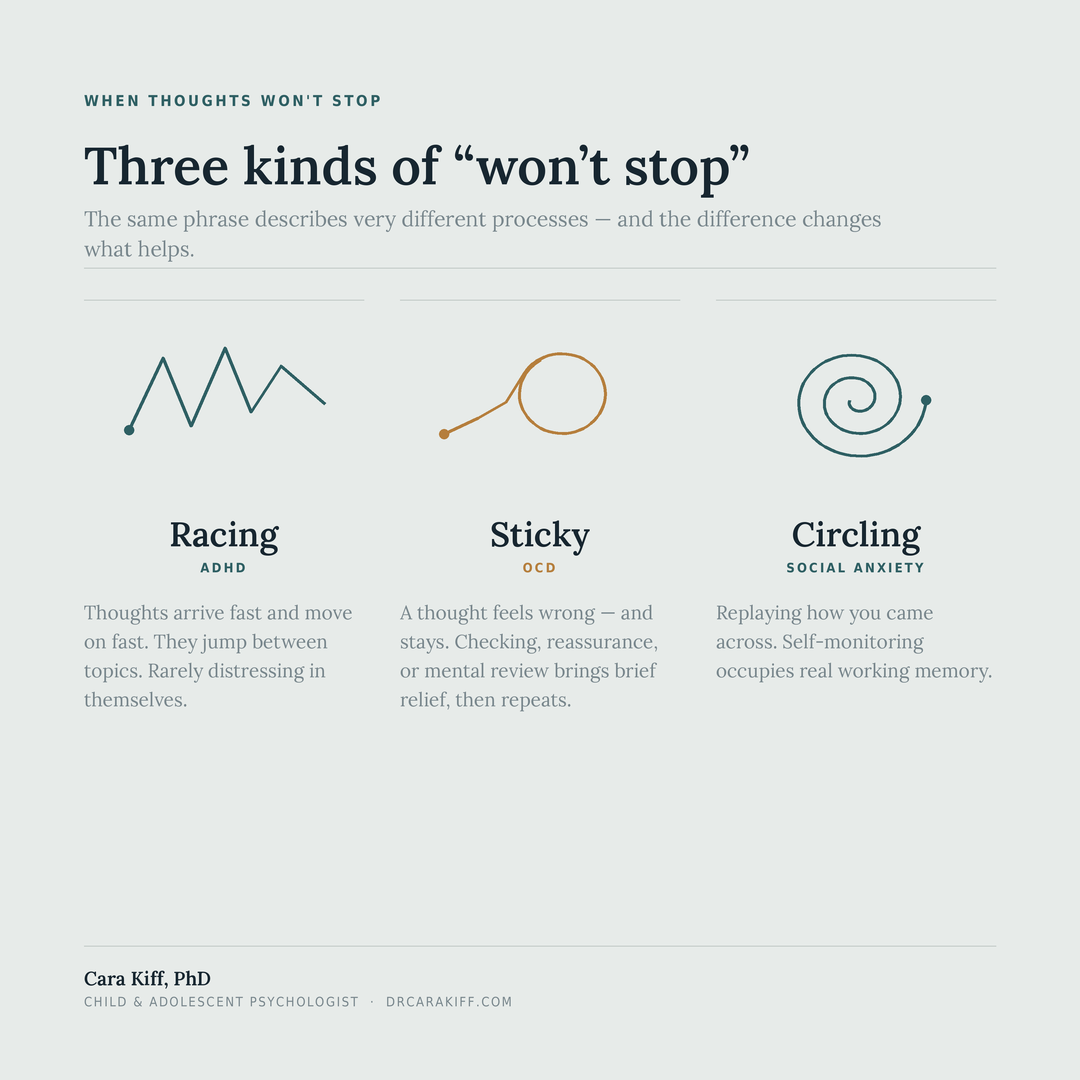
Racing thoughts (ADHD). Thoughts arrive fast and move on fast. They jump between topics. There's a sense of mental restlessness — thoughts that feel "constantly on the go." Research distinguishing racing thoughts from ordinary mind-wandering in adults with ADHD found racing thoughts were closely tied to emotional lability and mental restlessness, and formed a distinct phenomenon from daydreaming or spontaneous mind-wandering (Biernacki et al., Frontiers in Psychiatry, 2023). The key feature: the thoughts don't usually stick, and they don't usually feel morally alarming.
Intrusive thoughts (OCD). A thought arrives that feels wrong — unwanted, contrary to who you are, sometimes frightening. And then it stays. What defines OCD isn't the thought itself (most people have odd intrusive thoughts) but what happens next: the distress, and the effort to neutralize it through checking, reassurance-seeking, mental reviewing, or ritual. Those efforts work briefly, which is exactly why they strengthen the cycle.
Anticipatory social worry (social anxiety). Thoughts loop around how you came across, what someone meant by that pause, whether you said something wrong. This can look like OCD's mental reviewing, and it can look like ADHD's distractibility — because self-monitoring occupies real working memory.
Where it gets genuinely complicated
These co-occur far more often than people expect. A 2024 systematic review of 41 studies found that co-occurring social anxiety and ADHD was consistently associated with greater impairment than either condition alone, even though reported prevalence rates varied widely across studies (Jakobsson Støre et al., Journal of Attention Disorders). And anxiety disorders are among the most common comorbidities in OCD across the lifespan.
When all three are present, they don't just sit side by side — they feed each other:
ADHD impulsivity produces a blurted comment → social anxiety turns that into shame and replaying → OCD-style mental reviewing turns the replaying into a ritual that provides brief relief and gets stronger each time.
Or: an intrusive thought arrives → the ADHD-related difficulty with disengaging attention makes it harder to let go → the thought sticks longer than it otherwise would.
Why the distinction matters practically
Because the treatments pull in different directions.
Exposure and Response Prevention (ERP) for OCD asks you to sit with the discomfort without neutralizing it. Social anxiety treatment asks you to enter feared social situations and gather disconfirming evidence. ADHD support is largely about externalizing structure and building executive-function scaffolding. Applying the wrong one — treating genuine ADHD as an anxiety problem, or treating OCD as a focus problem — tends to produce slow progress and a lot of frustration.
What to bring to an evaluation
If this pattern sounds familiar, the most useful thing you can bring isn't a list of symptoms — it's a description of what you do in response to the thoughts. Do you check? Seek reassurance? Replay? Avoid? Or do the thoughts simply move on to the next thing? That functional question is often more diagnostic than the content of the thoughts themselves. 📎
References
Biernacki, K., et al. (2023). Disentangling racing thoughts from mind wandering in adult attention deficit hyperactivity disorder. Frontiers in Psychiatry.
Jakobsson Støre, S., Van Zalk, N., Granander Schwartz, W., Nilsson, V., & Tillfors, M. (2024). The relationship between social anxiety disorder and ADHD in adolescents and adults: A systematic review. Journal of Attention Disorders.
Sharma, E., et al. (2021). Comorbidities in obsessive-compulsive disorder across the lifespan: A systematic review and meta-analysis. Frontiers in Psychiatry.
American Psychiatric Association. (2022). Diagnostic and Statistical Manual of Mental Disorders (5th ed., text rev.).
The Performance Trap: How Perfectionism Weakens Your Child’s "Frustration Muscle"
In highly competitive environments — elite club sports, high-level performing arts, or advanced academics — we often praise the child who demands 100% excellence from themselves. We see their intense drive, their fury at their own mistakes, their refusal to settle for second best, and we label it "passion."
As a child clinical psychologist, I often see a hidden vulnerability beneath this drive.
Frequently, what looks like a dedication to excellence is actually a combination of perfectionism and low frustration tolerance.
Researchers separate perfectionism into two distinct categories: perfectionistic strivings (maintaining high personal standards) and perfectionistic concerns (a chronic fear of failure, mistakes, and negative evaluation). A comprehensive meta-analysis of 52 studies in competitive sport found that perfectionistic concerns were consistently linked to worse motivation and emotional well-being — including a small-to-moderate relationship with burnout — while perfectionistic strivings showed a much more mixed picture (Hill, Mallinson-Howard, & Jowett, 2018). The concerns side of perfectionism, in other words, is the one worth watching.
Perfectionism sets an impossible standard — the belief that a child must be flawless to be worthy. Frustration tolerance is the psychological capacity needed to cope when reality falls short of that standard. When that capacity is underdeveloped, perfectionistic concerns become a trap: because the child can't tolerate the discomfort of an error, they become risk-averse, easily discouraged, or prone to emotional meltdowns.
The Hidden Signs of a Faltering Frustration Muscle
Parents often look for obvious signs of frustration — a classic tantrum, a broken tennis racket. But in highly capable, competitive kids, this usually wears a disguise. Watch for these three subtler patterns:
The Procrastination Loop. Suddenly putting off a big project, dragging their feet to practice, appearing "lazy"? This is rarely a lack of motivation — it's a defense mechanism. If they don't try, they can't truly fail.
"Quitting While Ahead." Many perfectionistic kids lose interest in an activity the moment it shifts from "easy and fun" to "challenging and requiring effort." A three-month longitudinal study of 101 junior athletes (mean age 17.7) found that perfectionistic concerns specifically predicted increases in burnout over time, while perfectionistic strivings alone tended to predict decreases (Madigan, Stoeber, & Passfield, 2015). The pattern shows up as kids exiting an activity while their sense of themselves is still intact, rather than staying and risking a second imperfect showing.
Somatic Escape Hatches. Frequent stomachaches, headaches, or fatigue that conveniently strike on the morning of a big exam, game, or recital. When a child's mind can't tolerate the anticipatory anxiety of a non-perfect outcome, the nervous system sometimes manufactures a physical off-ramp.
To dismantle this pattern, we build frustration tolerance using four everyday pillars.
1. The Art of Waiting (Dismantling the "Instant Mastery" Expectation)
Perfectionistic children often carry a rigid timeline: they should master a skill immediately, catch on instantly, achieve top status right away. Because they lack the tolerance to endure the "imperfect" phase of learning, having to practice or wait feels like proof they're failing.
The trap: without immediate results, the perfectionist child often wants to quit rather than sit with being a beginner.
Building the muscle: shift the focus from end result to incremental process. This aligns with what we know about how children's brains handle frustration in the first place: neuroimaging research in young children has found that the lateral prefrontal cortex — the region most associated with cognitive control and emotion regulation — becomes actively engaged specifically during moments of frustration, with children who find frustration harder showing the greatest activation in this region (Perlman, Luna, Hein, & Huppert, 2014). In other words, tolerating frustration isn't a passive experience for a developing brain — it's the exact moment this regulatory circuitry is doing its work. That's the developmental argument for letting a child stay in the "messy middle" rather than rescuing them from it, though it's worth being honest that this specific finding is about what's happening in the moment, not a guarantee that any one difficult moment permanently builds the skill — tolerance develops through many such moments over time, generally with support.
What to say: "You haven't mastered this yet, and that's exactly where you're supposed to be. Growth takes time, and sitting with the frustration of waiting for it to click is part of how kids get better at handling bigger challenges."
2. Coping with Losing (Decoupling Worth from Outcomes)
For a perfectionist, a setback — losing a game, a B on a test, missing the lead role — is a threat to identity. Not "I had a bad day" but "I am a failure." Because that sting is intolerable, they melt down, blame external factors, or mentally check out to protect their ego.
The trap: they can't tolerate losing because they believe mistakes make them less worthy of approval.
Building the muscle: separate who they are from what they do. On the ride home from a tough performance, resist dissecting errors or scores. Praise character and resilience instead. Losing is data, not a verdict.
What to say: "I loved your grit today. Things didn't go your way early on, and you kept your head up and stayed focused. That's real maturity."
3. Being Happy for Others (Breaking the Comparison Curse)
Perfectionism thrives on social comparison. If a teammate gets the praise or the spotlight, the perfectionistic child can experience it as a personal failure — leading to silent resentment or harsh self-criticism.
The trap: success feels like a finite pie — someone else's slice means less for them.
Building the muscle: help them see that a peer's success doesn't diminish their own. Redirect toward collaboration.
What to say: "How did Chloe's great performance help the whole group today? How do your different strengths work together?"
4. Taking Turns (Surrendering the Need for Control)
Perfectionists often carry an intense need for control. Sharing the spotlight or stepping into a supporting role can feel threatening — as if things will go wrong, or they'll be overlooked, without their hand on it.
The trap: they'd rather carry an entire project alone and burn out than trust someone else with a turn.
Building the muscle: redefine what a "successful turn" looks like when they're not center stage. Give them a specific, controllable job within a supporting role.
What to say: "Your job right now is to be the ultimate teammate on the sidelines," or "Today your turn is using your skills to help set someone else up."
The Check-In for Parents
It's easy to inadvertently feed this trap. If our first questions are always about outcomes — "Did you win? What grade did you get? Did the coach notice you?" — we reinforce the idea that results are what matter most.
To break the trap, we become a safe harbor where our children don't have to be flawless to be prized. Let them see you handle your own mistakes without falling apart. Keep your love and pride visibly decoupled from their achievements. When a child realizes an imperfect performance won't cost them your approval, they gain the freedom to sit with frustration, take healthy risks, and reach further than perfectionism alone would ever let them.
— Dr. Cara Kiff 📎
References
Hill, A. P., Mallinson-Howard, S. H., & Jowett, G. E. (2018). Multidimensional perfectionism in sport: A meta-analytical review. Sport, Exercise, and Performance Psychology, 7(3), 235–270.
Madigan, D. J., Stoeber, J., & Passfield, L. (2015). Perfectionism and burnout in junior athletes: A three-month longitudinal study. Journal of Sport & Exercise Psychology, 37(3), 305–315.
Perlman, S. B., Luna, B., Hein, T. C., & Huppert, T. J. (2014). fNIRS evidence of prefrontal regulation of frustration in early childhood. NeuroImage, 85(1), 326–334.